
About Me:
My name is Callum Pearce and I am an aspiring Game Developer/Designer
I possess many skills that will credit me for my future, and my goal is to one day work for a major company and begin making my own games.
Contact me at callump989@gmail.com for further inquiries
DISCLAIMER:
I completed college in 2024 and chose not to progress directly to university, as I was uncertain about my long-term direction at the time. After taking some time away, I decided I wanted to pursue a higher education. Unfortunately, my portfolio contains limited evidence of my college work, as it was created using my college email account, which was deleted after I left. The work submitted here represents all the material I am currently able to provide and reflects my abilities to the best of my capacity in support of my application.
My Work
Map Sketches and Artwork

This sketch was created for a maze based game I had drafted up as part of a college project.

This sketch was originally for a multiple story side scrolling platformer that was required for a project

This is a Pokeball that I created from pixel art for one of my previous projects.
This sketch was created for a maze based game I had drafted up as part of a college project.
Screenshots

This image came from my first ever major project in college. We were tasked to create a final boss level layout so my choice was to use The Winged Dragon of Ra from Yu-Gi-Oh, which I found a model for on SketchFab. The VFX came from the Unreal Engine marketplace, while the remainder of the assets were made from the starter content.

This image came from the 2.5D side scroller game I created for my final major project in my first year. The game was created to be a mashup between Super Mario and Pokemon, where the player would go from left to right, capturing pokemon and advancing to each stage.

This was a Pokemon Sprite that I had animated myself in Unreal Engine which was part of my 2.5D side scroller. I had created other models such as numerous different pokemon and the character model too, however I was unable to find any documentation.
This image came from my first ever major project in college. We were tasked to create a final boss level layout so my choice was to use The Winged Dragon of Ra from Yu-Gi-Oh, which I found a model for on SketchFab. The VFX came from the Unreal Engine marketplace, while the remainder of the assets were made from the starter content.
This is a collection of all the sketches I had saved from when I was in college. All of them are map designs which I made for college projects and just for fun. The three uncoloured sketches were created as we needed to create 3 sketches for three different game genres, and choose the favourite and expand upon it.
All of the screenshots that I have managed to salvage are within this gallery. These screenshots vary from character models and assets, level designs, and blueprints.
Best Work
Sockets Adventure: Beware Of The Deep

One of my proudest projects is a side-scrolling platform game titled Socket’s Adventure: Beware of the Deep, which I developed during my second year of college. While the project was not fully completed, it resulted in a well-designed and highly detailed prototype that demonstrates my approach to game design and player communication.
Alongside the game, I designed a promotional poster that explored the narrative and lore of the project, providing background on the main character, Socket, and the world they inhabit. The poster also clearly presents gameplay information, including control layouts, the character model, and screenshots showcasing the game’s level design. This was created to effectively communicate the game’s identity, mechanics, and tone to both players and viewers.
This project reflects my ability to develop a concept by combining visual presentation, narrative elements, and level design to support an engaging side-scrolling platform experience.
Reflection:
If I were to continue development on this project, I would focus on expanding the core gameplay mechanics and completing additional levels to further explore pacing and difficulty progression. I would also prioritise user testing to refine controls, improve level flow, and better balance challenge and accessibility. This project helped me understand the importance of scoping ideas realistically, as well as the value of clear visual communication.
Screenshots

This image is a front facing viewing of my player character model "Socket"

This is a backward facing viewing of my player character model "Socket"
This screenshot depicts an NPC I included in the level. Originally, the lore of the character was that he was a previous employer of the main antagonist of the game. He gives helpful tips and hints to the player as he progresses to make the level easier.
This image is a front facing viewing of my player character model "Socket"
Pokemon Pixel Rush
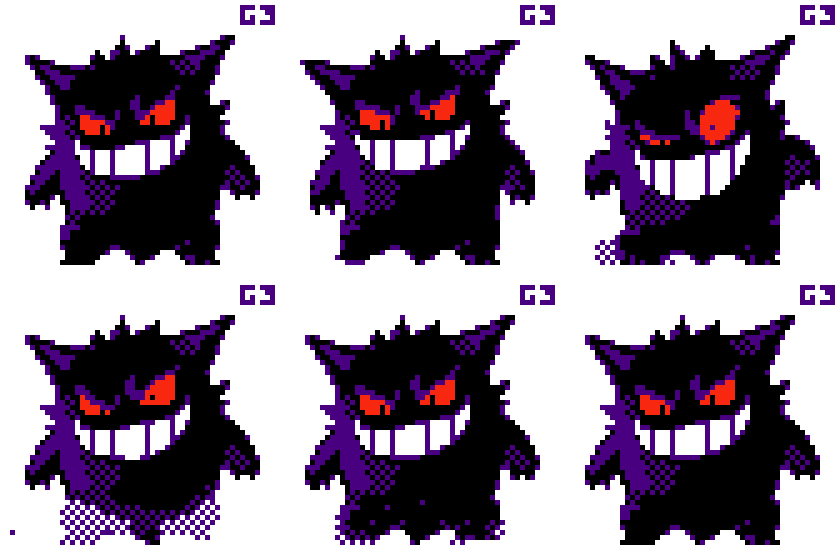
For my Final Major Project (FMP) in college, I designed and developed a 2.5D side-scrolling game titled Pokémon Pixel Rush, drawing inspiration from the level-based gameplay of Super Mario and the mechanics and visual identity of Pokémon. The project focused on creating an accessible yet engaging player experience through clear progression, intuitive controls, and familiar game systems.
The main goal was to guide the player from left to right through each level while throwing them into challenging environments through Pokémon capture mechanics. I initially planned to implement a turn-based battle system triggered by proximity to wild Pokémon; however, due to the six-week development timeframe, I had to make the decision to prioritise core gameplay systems and overall playability.
The final game features four fully playable levels, each designed using original pixel art assets created by me, including character sprites, environment art for level design, and interactive items. A capture system allows players to collect and throw Poké Balls to capture Pokémon encountered in the levels, which are then stored within a custom inventory system I designed and implemented. This system was intended to reinforce player progression and reward exploration.
By blending side-scrolling platform mechanics, camera perspective, and audio design inspired by Super Mario with Pokémon-style collection mechanics and pixel art aesthetics, the project demonstrates my ability to combine existing design influences into a cohesive and original gameplay experience.
Although visual documentation is limited due to the time elapsed since development, the included portfolio images accurately reflect the final outcome of the project.
This project strengthened my understanding of prioritisation and knowing to focus on the more achievable tasks before tackling more time consuming ones. I learned the importance of identifying and cleaning up core mechanics early to ensure a playable and engaging experience. If I were to continue development, I would expand the battle system and introduce more varied level challenges, supported by playtesting to further refine pacing, difficulty, and player feedback.
Uncharted Project

Another project I completed involved designing a tutorial level inspired by Uncharted 4: A Thief’s End. At the start of the project, we were provided with a video package outlining the assets that were necessary to use, which included environmental props, rigged character models, weapons, consumables, visual effects, and interactive mechanics such as grappling hooks. The aim was to design a level that effectively introduced players to the game’s core systems using these assets.
Before beginning level construction, I produced a series of map sketches as part of the project criteria, which are included in the slides above. These sketches allowed me to plan layout, pacing, and player flow before moving into development. My design goal was to create a tutorial level that was simple, clear, and visually engaging, while gradually introducing all of the game’s key mechanics. These included movement mechanics such as running, jumping, and rolling, as well as combat systems, consumables, weapons, interactive walls and platforms and the use of the grappling hook.
The level was structured to introduce mechanics progressively as the player advances. The player begins in a seemingly hostile environment where essential weapons can be found, subtly foreshadowing upcoming combat encounters. This is followed by a low-risk combat scenario involving a single enemy, allowing the player to learn combat mechanics without becoming overwhelmed. The level then expands into traversal challenges, including climbing scalable walls, jumping between spaced platforms, and using the grappling hook to cross a hazardous river.
Reflection:
This project helped me develop a stronger understanding of tutorial and onboarding design, particularly the importance of teaching mechanics through level structure rather than explicit instruction. I learned how pacing, environmental cues, and controlled challenges can be used to guide player behaviour and reinforce learning. If continued, I would further refine the level through playtesting to improve flow, clarity, and difficulty balance.